From Baby Formula Reform to Kennedy’s Political Future
By Dr. Jill Glasspool Malone and Robert W. Malone
Last September 30, Robert and I published an exposé titled Operation Stork Stall, revealing something rather astonishing about American infant formula.
The FDA does not require manufacturers to disclose how many grams of Total Sugars or Added Sugars are in infant formula. Some products even list corn syrup as their first ingredient. Yet parents cannot look at the nutritional panel and determine how much sugar their babies are consuming.
Think about that. A jar of baby food must disclose its sugar content, but infant formula, which may provide virtually every calorie a newborn consumes for months, is exempt.
We also documented how Operation Stork Speed, announced by Secretary Kennedy in March 2025 with promises of “radical transparency,” had accomplished relatively little in changing the actual formula being sold to American families.
Now, here is where the story gets interesting.
At the time, Calley Means was still communicating with Robert. Since leaving his HHS position, however, Means has essentially cut off communication, as have others associated with the MAHA political organizations.
We have been told that Secretary Kennedy is, as one person described it, “big mad” at Robert.
My impression is that certain elements of the MAHA establishment have become increasingly interested in controlling the narrative and ostracizing those who independently investigate and report on what is happening. Activists who promote the movement are welcome. Independent journalists asking uncomfortable questions? Apparently, not so much.
But before that breakdown in communication, we made certain that our infant formula investigation reached Calley Means.
He told us that he, Secretary Kennedy, and senior HHS leadership had been unaware of the specific sugar-labeling exemption we documented. He promised to circulate our article to FDA Commissioner Heidi Overton and other FDA officials.
We hoped he would follow through.
Fast-forward to October 29.
Secretary Kennedy announced that the FDA is moving forward with its first comprehensive review of infant formula nutrient requirements in nearly 30 years.
As Kennedy explained, the science has evolved, and the agency is now comparing American infant formula standards with more recent research and European standards.
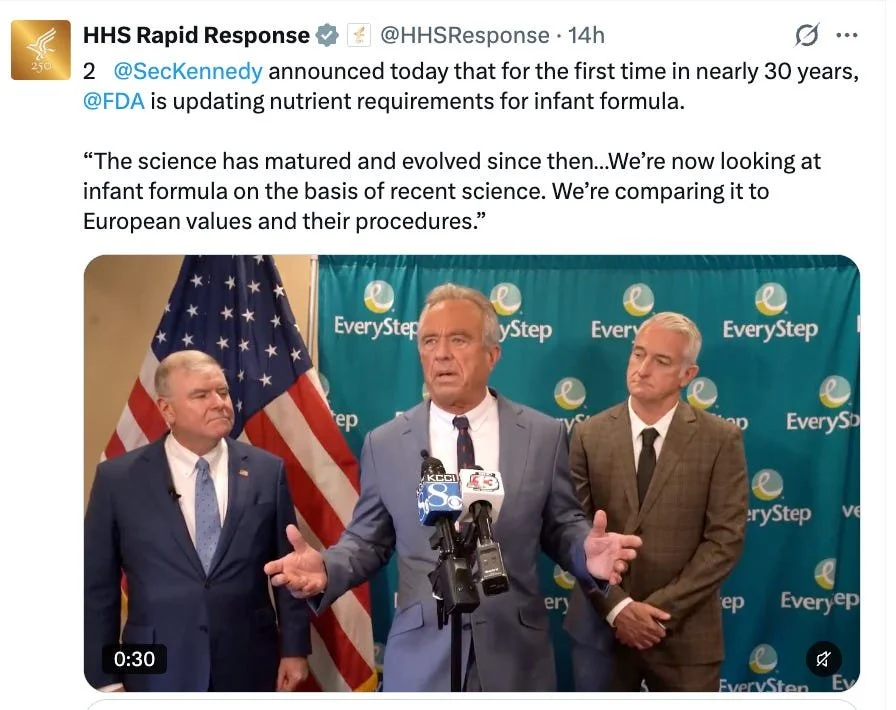
Those words, “European values,” are particularly significant. As we had documented, European infant formula regulations impose tighter restrictions on certain carbohydrate sources, including glucose syrup, sucrose, and other sugars. The European Union also maintains detailed standards governing ingredients, additives, and nutritional composition. These differences go directly to the heart of our September investigation, which exposed the use of corn syrup-derived ingredients in American infant formula and the FDA’s extraordinary exemption allowing manufacturers to omit Total Sugars and Added Sugars from nutrition labels.
Kennedy’s reference to European standards suggests that the administration may finally be examining the very regulatory differences we brought to HHS leadership’s attention.
The FDA has now proposed changes affecting eight nutrients, including iodine, manganese, and vitamins A and D. Additional reviews are planned, including an examination of carbohydrate sources.
That is welcome progress, and credit should be given where it is due.
However, the FDA initiated its comprehensive nutrient review before our September investigation. What we specifically brought to MAHA leadership’s attention was the longstanding regulatory exemption that allows infant formula manufacturers to withhold basic sugar-content information from parents.
And that problem remains unresolved.
The current proposal does not eliminate the sugar-labeling exemption. Carbohydrate sources are scheduled for examination in a later phase, but there is no guarantee that the FDA will ultimately require manufacturers to disclose Total Sugars and Added Sugars.
We cannot know whether our investigation helped bring additional attention to this issue within HHS or FDA. What we do know is that we documented the problem, delivered our findings to someone with direct access to senior leadership, and received assurances that the information would be circulated.
Perhaps our reporting helped move the conversation forward. We certainly hope so.
But the fundamental question remains: Why should American parents have to wait years for the FDA to require infant formula manufacturers to disclose information they already possess?
And there is a larger issue here, one that goes well beyond infant formula.
Independent journalism is not supposed to function as the public relations department for politicians, government agencies, or political movements. We support reforms that improve American health, regardless of who implements them, and we will give credit when meaningful progress is made.
But supporting the goals of MAHA does not mean surrendering our independence to its political leadership, remaining silent when promises go unfulfilled, or overlooking failures simply because the people responsible happen to be on our side.
Accountability cannot be reserved exclusively for political opponents.
Our job is to investigate, document, and ask difficult questions, including those that make people in positions of power uncomfortable.
And that is exactly what we intend to keep doing.
What Happens to MAHA if Democrats Take Congress?
The future of the MAGA-MAHA alliance, the emergence of an independent MAHA political movement, and Robert F. Kennedy Jr.’s uncertain political future.
By: Dr Robert Malone
The following analysis is for paid subscribers only.
The Future of MAHA: Absorption, Recession, or Reinvention?
If Democrats win control of the House in the midterm elections, and potentially the Senate as well, what happens to MAHA?
My assessment is that the most plausible scenario is partial absorption of the MAHA agenda into the two major political parties. A second possibility is that the movement enters a period of political recession, losing momentum and influence as the governing environment becomes increasingly hostile.
Both political parties have reasons to embrace selected elements of MAHA. There are already clear indications that Democrats are attempting to attract disaffected MAHA supporters, particularly those concerned about food safety, pesticides, chronic disease, and corporate influence over federal health policy. Some Democratic candidates are openly positioning themselves as alternatives for voters who support MAHA’s health reform agenda but have grown dissatisfied with the Republican Party.
However, there is a fundamental contradiction that neither party can easily escape. Both Republicans and Democrats operate within a political system heavily influenced by corporate lobbying, campaign contributions, and the revolving door between government and industry. Big Pharma and Big Ag are among the most influential interests in Washington, spending hundreds of millions of dollars annually to shape legislation and regulatory policy. The pharmaceutical and health products industry alone spent approximately $452 million on federal lobbying in 2025.
This raises an uncomfortable question: How seriously can either party pursue MAHA’s central objective of reducing corporate influence over public health policy when both remain financially and politically entangled with the very industries they are supposed to regulate?
The danger is that both parties will selectively embrace MAHA’s most popular talking points while leaving the underlying system of regulatory capture largely untouched.
At the same time, MAHA’s emerging corporate and political structures may attempt to establish the movement as an independent political force. If that effort develops into a separate MAHA party, its leadership could seek to occupy the political center, attracting disaffected Republicans and Democrats alike.
However, MAHA will first have to overcome growing concerns that it is becoming another vehicle for the very corporate interests it originally promised to challenge. The recent MAHA Institute conference illustrates the problem, with corporate sponsors reportedly paying substantial sums for access to senior HHS officials, speaking opportunities, and a seat at the table. Such arrangements raise serious questions about whether the movement is genuinely committed to ending regulatory capture or simply replacing one set of politically connected insiders with another.
Despite these contradictions, an independent MAHA party could potentially negotiate alliances with both Republicans and Democrats, exercising political influence without being fully absorbed by either. In effect, this would represent an attempt to establish something resembling a coalition-government model within America’s two-party system.
The irony would be difficult to ignore: a movement founded to challenge corporate influence over public health could end up becoming another political organization financed and influenced by the same powerful interests.
There is also a scenario in which Kennedy, potentially alongside Tulsi Gabbard, seeks a future presidential nomination as a Democrat or under an independent MAHA banner. While speculative, the emergence of multiple MAHA-aligned super PACs and the continued promotion of Kennedy as the movement’s political savior suggest that this possibility should not be dismissed.
It is important to remember that MAHA largely emerged from the political left, while MAGA emerged from the right. Their alliance was never based on a fully shared political philosophy.
The MAGA-MAHA Alliance: A Coalition of Convenience
In retrospect, the MAGA-MAHA alliance increasingly resembles a shotgun wedding, a coalition of convenience rather than a durable political partnership.
MAGA has lost considerable energy for several reasons, including perceptions of self-serving behavior and political as well as financial profiteering within its ranks, growing dissatisfaction over the war with Iran, and internal divisions over American support for Israel.
MAHA faces its own problems.
Many of the core concerns identified in the original MAHA Commission report remain unresolved. For supporters who expected meaningful action on medical freedom, vaccine mandates, regulatory reform, the continued push for more RNA vaccines, and the influence of pharmaceutical companies, the pace and scope of change have generated disappointment.
The prevailing explanation among Kennedy’s defenders is that he has been fighting courageously against entrenched bureaucratic interests, but that resistance from the so-called deep state has prevented him from delivering on his promises.
This is another variation of the “Bobby is a victim of...” narrative we examined in earlier essays, including The Kennedy Exception.
That explanation may resonate with loyal supporters, but it does not resolve the underlying question of accountability. At what point must political leaders be judged by what they accomplish rather than by the obstacles they say they face?
There is another important source of tension. Many of the populists who joined the MAHA coalition are strongly anti-war. The conflict with Iran has therefore created an additional strain on an alliance that was already politically fragile.
What a Democratic Congress Would Mean for MAHA
If Republicans suffer a major setback in the midterms, the consequences for the administration’s health reform agenda could be substantial.
I would anticipate significant personnel changes, administrative restructuring among political appointees, and a more defensive posture throughout HHS and its agencies.
A Democratic-controlled House would have the power to initiate investigations, compel testimony, and conduct extensive oversight hearings. If Democrats also gain control of the Senate, Kennedy could face sustained scrutiny from both chambers.
I have already received additional letters from Senator Blumenthal’s staff demanding personal information, which I consider threatening and politically motivated. One might reasonably expect the administration to defend a former ACIP member against what I view as congressional intimidation and prosecutorial overreach. Unfortunately, anyone making that assumption would be sadly mistaken.
Under those circumstances, the administration would likely be forced to devote considerable time and resources to responding to congressional investigations. Ambitious reform initiatives could give way to retrenchment and more modest regulatory changes at the margins.
Another possibility is a pivot toward bipartisan programs, particularly those aspects of MAHA that enjoy support across party lines, such as food quality, chronic disease prevention, and certain environmental health concerns.
There is also a more provocative possibility.
Kennedy has repeatedly suggested that Trump would give him greater freedom to pursue vaccine policy after the midterms. If that promise were fulfilled, the administration could attempt more aggressive changes precisely when congressional opposition is intensifying. Personally, I consider that scenario unlikely.
As the 2028 election looms large, I don’t think the White House staff would see any benefit in Kennedy pursuing more aggressive vaccine reforms over the next two years.
Plus, a weakened Republican administration facing hostile congressional oversight would have limited political incentives to initiate another major confrontation over vaccine policy.
Will Kennedy Stay or Leave?
Rumors are circulating that both Kennedy and White House Chief of Staff Susie Wiles could depart following a major Republican setback in the midterms.
I have no interest in reporting those rumors as fact. Having been badly burned by relying on such information in the past, I now discount much of it as political noise, disinformation, or some combination of the two.
Kennedy’s stated personal position is that he is not a quitter and intends to remain in office.
There is also some firsthand information that supports that position.
I recently spoke with a candidate who was being interviewed by Kennedy for a senior position supporting his work. According to that individual, their discussions included the likelihood of a highly hostile congressional oversight environment and the need to be prepared to tolerate sustained political pressure.
That does not sound like someone who is actively preparing to leave.
Nevertheless, Kennedy would become an obvious target for Democratic congressional investigations. His vaccine policies, administrative decisions, personnel appointments, and relationships with outside MAHA organizations would likely attract substantial scrutiny. And, of course, the Skyhorse book deal.
Whether he would choose to endure that environment is another question.
The Emerging MAHA Party and the Vance Problem
The apparent effort to develop MAHA into an independent political organization introduces another complication.
An independent MAHA political structure would almost certainly continue promoting Kennedy as its central public figure. That could create increasing tension with Republican leadership, particularly as Vice President JD Vance positions himself for a potential presidential run.
A movement built around Kennedy’s political identity could eventually compete with Republican candidates for some of the same voters. Whether MAHA remains an advocacy movement, operates within the existing two-party system, or attempts to establish a genuine third party will determine the extent of that competition.
For Kennedy, the challenge will be maintaining influence within the Trump administration while preserving the political independence and personal following that made him valuable to the Republican coalition.
There are also incentives to pursue a presidential campaign without any realistic expectation of winning. Former presidential rivals are sometimes considered as vice-presidential running mates, and even an unsuccessful campaign can increase a candidate’s political leverage. A well-funded super PAC can also provide lucrative opportunities for politically connected consultants, family members, and campaign operatives. Meanwhile, campaigns and supporting organizations can cover legitimate travel, meals, lodging, and other campaign-related expenses, providing considerable financial benefits to the candidates themselves.
The question is whether Kennedy can continue serving in a Republican administration while simultaneously building a political movement that may ultimately compete with it. The answer is no; an active presidential campaign would create serious conflicts with his responsibilities as HHS Secretary. In practical terms, Kennedy would almost certainly have to leave the administration to pursue an independent presidential bid.
Kennedy’s Exit Strategy: Departure or Political Survival?
If Kennedy ultimately leaves HHS, he will face a difficult political problem.
His supporters were promised substantial reforms, particularly concerning medical freedom, vaccine mandates, and the regulation of newer genetic vaccine technologies. To the extent those promises remain unfulfilled, Kennedy will need to explain why.
A departure from the administration would require a compelling public narrative capable of preserving his credibility with a disappointed base.
One possibility is that he portrays his departure as the consequence of entrenched institutional resistance, returning to the familiar image of Kennedy as the underdog fighting powerful and corrupt interests.
But there is another possibility.
Remaining in office and confronting aggressive Democratic oversight could actually provide Kennedy with an opportunity to rebuild his standing among supporters.
A prolonged confrontation with congressional investigators would allow him to present himself once again as a political outsider battling the establishment. In that environment, the familiar “RFK as victim” narrative could regain considerable force.
In other words, the very political pressure that might drive him from office could also become the foundation of his political rehabilitation.
My Assessment
On balance, I suspect Kennedy will depart the administration at some point within the next year or so. That is a tentative judgment, not a firm prediction, and there are credible reasons he might choose to stay and weather the coming storm.
The more consequential question, however, is what becomes of MAHA itself.
If the Republicans lose control of Congress, the movement will face a fundamental choice: remain tied to a weakened Republican administration, seek common ground with Democrats, or attempt to establish an independent political identity.
Each path risks alienating part of the coalition.
The MAGA-MAHA alliance brought together constituencies with very different political histories, priorities, and expectations. Its durability depended heavily on the promise that meaningful health reform would follow.
If those reforms fail to materialize, political loyalty alone may not be enough to hold the coalition together.
Ultimately, the future of MAHA may depend less on Kennedy’s personal political survival than on whether the movement can demonstrate that it is capable of delivering substantive reform rather than simply sustaining another political personality and the organizations built around him.