
Melanoma: Forty-Four Billion Dollars, No Numbers
Bottom line on the Merck/Moderna immunotherapy product press release
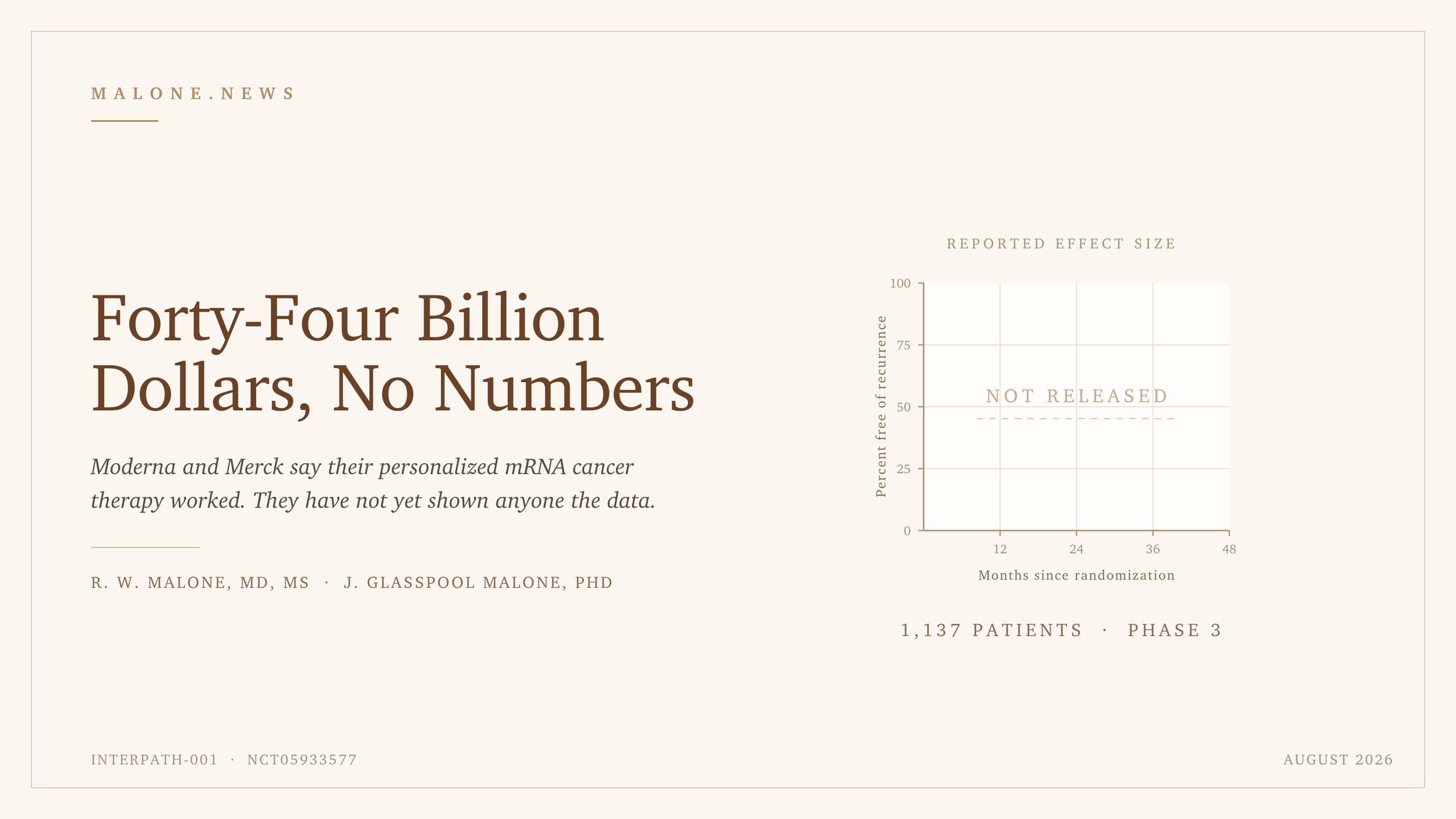
Forty-Four Billion Dollars, No Data
Moderna and Merck say their personalized mRNA cancer therapy worked in a large melanoma trial. They have not yet shown anyone the data. The distance between those two facts is the story.
By Robert W. Malone, MD, MS, and Jill Glasspool Malone, PhD
On the morning of August 19, Merck and Moderna issued a press release. It said that a large clinical trial of a personalized mRNA product, given alongside Merck’s cancer drug Keytruda, had succeeded in patients whose melanoma had been surgically removed (Merck and Moderna 2026a).
By the closing bell, Moderna’s stock had risen 177 percent. The company’s market value went from about $25 billion to about $69 billion in one trading session. Trading volume ran roughly nineteen times its three-month average (Motley Fool 2026). Merck gained more than 12 percent (CNBC 2026). Headlines around the world announced that an mRNA cancer vaccine had finally worked.
We should be plain about our interest before going further. One of us designed and implemented the core messenger RNA construct that remains in use today. He also developed the benchtop version of the manufacturing process the industry later scaled, and wrote the initial patent disclosures in the late 1980s covering the use of RNA as a drug and its application to vaccination. That is the documented basis for the claim to original inventorship of this platform. It rests on the patent record and its filing dates.
It has never included a claim to have invented the COVID vaccines, or to have worked alone. Read what follows as the assessment of people who would like this technology to succeed, and who also read the fine print.
The press release contains no numbers.
What the product is
Some vocabulary first, because the coverage has been sloppy with it.
Every tumor carries mutations. Those mutations produce slightly altered proteins that the patient’s own healthy cells do not make. Immunologists call these altered proteins neoantigens, meaning new antigens. In principle, they are flags the immune system could learn to recognize.
The Merck and Moderna product, now named intismeran autogene, works from that idea. A surgeon removes the tumor. A laboratory sequences it and identifies mutations unique to that patient. Software picks up to 34 of them. A custom mRNA molecule is then synthesized that instructs the patient’s cells to manufacture those specific flagged proteins, wrapped in the same fatty particles used in the COVID shots (Merck and Moderna 2026a).
The patient receives nine injections over about six months. That is the Moderna component alone. Counted alongside the Keytruda infusions, the earlier trial asked patients for twenty-seven administrations across a year, and the current one asks for eighteen (Weber et al. 2024; Merck and Moderna 2026a). Claims circulating online that Moderna's product is itself an eighteen- or twenty-seven-injection course are wrong. Those totals include Merck's antibody drug, which has been in use since 2014 and is given intravenously.
Keytruda does something different. It releases a brake that tumors use to switch off immune cells that would otherwise attack them. The theory of the combination is that one drug supplies the target and the other removes the restraint.
Moderna no longer calls this a vaccine. The company calls it an individualized neoantigen therapy, and that is the honest description (Boston Globe 2026). Nobody is preventing melanoma with this. It is given to people who already had the disease cut out, to reduce the chance that it returns. Physicians call that adjuvant treatment. Most of the press has gone on using the word vaccine anyway, and that word is doing work in this debate that the underlying science does not support.
What the announcement actually said
The trial is called INTerpath-001. It enrolled 1,137 patients whose melanoma had been completely removed. Two-thirds received the personalized injections plus Keytruda. One third received Keytruda alone. Treatment ran about a year (Merck and Moderna 2026a).
The companies report that the combination beat Keytruda alone on two measures. The first is recurrence-free survival, meaning how long patients go before the cancer comes back or they die. The second is distant metastasis-free survival, meaning how long before the cancer appears somewhere far from the original site.
Now consider what the release does not contain. There is no hazard ratio, which is the standard measure of how much a treatment reduces risk. There is no confidence interval, which tells a reader how precise that estimate is. There is no p-value. There is no count of how many patients in each group actually relapsed. There are no survival curves. There is no breakdown by disease stage. The phrase used is “statistically significant and clinically meaningful,” which is a claim about numbers rather than the numbers themselves.
The release is not short on language, only on data. Professor Georgina Long of Melanoma Institute Australia, the trial’s principal investigator, called the result “a landmark moment for adjuvant melanoma treatment” (AJMC 2026). Stephane Bancel, Moderna’s chief executive, described the findings as “a pivotal moment for the field of cancer research” (Merck and Moderna 2026a).
Both statements may prove correct. Neither can be checked by anyone outside the sponsor, because the release supplies no figure against which to test them.
A pharmaceutical company telling you its result was clinically meaningful, without showing you the result, is an advertisement. It may happen to be true. It may also fail to survive independent expert scrutiny.
Two further details in the release deserve attention. The result comes from a planned interim look, taken before the trial finished. Trials reported at the first moment they cross a statistical threshold tend to overstate the size of the benefit compared with the final tally. That is a known property of the method, not an accusation.
Interim looks are legitimate, and they exist for a sound reason. If a treatment is plainly working, it becomes hard to justify keeping the comparison group from it. But they are not free. Each look spends part of a fixed error budget, so whatever remains for the final analysis must clear a stricter bar, and trials are enlarged in advance to absorb the cost. The companies have not said how many looks were planned, how much of the budget this one consumed, or which threshold it crossed. Without those three figures, a reader outside the sponsor cannot judge how strong the result was. Only that it was strong enough to announce.
Note also what did not happen. The trial did not stop. It continues to measure whether anyone lives longer. What ended early was the wait for a headline.
Overall survival, the measure of whether patients live longer, is not yet available. The release states plainly that the study continues in order to assess it (Merck and Moderna 2026a).
If you own MRNA or MRK, or watched Monday's move and wondered whether to chase it, the section you just read is the entire public factual basis for a 177 percent single-day gain. Everything below is what it didn't include.
The 157-patient trial this whole program rests on, and the confidence interval in its first published result that touched the line of no effect. The 53 percent survival improvement now circulating in the financial press, and why the study’s own authors labeled that number exploratory and not statistically valid. The comparison drug has been in trials since 2015 without anyone yet demonstrating that a single patient lived longer, which is the regulatory foundation this approval will be built on. Bank of America’s own admission that its team spoke with management before writing the note that moved the models, while retail investors got a press release with no effect size. JPMorgan’s arithmetic showing the melanoma result was worth roughly 3 percent of Moderna’s valuation, against a stock that doubled and then gave back 20 percent the next morning.
And the eight specific numbers to look for when the data are finally presented, which is when the market will find out whether Monday was information or enthusiasm.
We do not give investment advice, and we do not take pharmaceutical money or advertising. What we do is read the primary literature and report what it says, which is the same job the sell side does for its clients and does not do for you. Paid subscribers are why the work exists.
The evidence that already exists
Everything published about this combination rests on one earlier trial, KEYNOTE-942. It enrolled 157 patients, 107 on the combination and 50 on Keytruda alone (Targeted Oncology 2026). That is a small study by cancer trial standards.
It was also open-label. Doctors and patients knew who was getting what, and the treating physicians were the ones who decided whether a recurrence had occurred (Merck and Moderna 2026b). Blinding exists because human judgment bends toward expectation, and this study had no blinding
The first published result reduced the risk of recurrence by 44 percent. The confidence interval ran from 0.309 to 1.017 (Khattak et al. 2023). That interval matters. A hazard ratio of 1.0 means no effect at all. This interval reaches past 1.0, meaning the data were still statistically compatible with the therapy doing nothing. The trial was declared positive using a one-sided statistical test set in advance, which is a legitimate design choice and a fragile one.
Five-year results, published this June, held up better. Recurrence risk was reduced 49 percent, with an interval of 0.294 to 0.887. Distant spread was reduced 59 percent, interval 0.200 to 0.843 (Khattak et al. 2026). The effect did not fade with time, which is genuinely encouraging.
Then there is the survival figure now circulating. Several outlets reported that the combination improved overall survival by 53 percent (BioSpace 2026). The published value is a hazard ratio of 0.471 with a confidence interval running from 0.165 to 1.345 (Merck and Moderna 2026b). Translated: the true effect could be a 53 percent reduction in deaths, or it could be a 35 percent increase. The study’s own authors classified this as exploratory, because the trial was never large enough to measure survival and no statistical allowance was reserved for testing it (Targeted Oncology 2026).
Reporting that number as a finding is the single clearest example of what has gone wrong in the coverage.
The problem that predates this drug
The criticism now widens beyond Moderna. It applies to the comparison drug as much as to the new one.
Both measures used in this trial are stand-ins. Delaying recurrence is desirable, but it is not the same as living longer. Regulators accept these stand-ins on the assumption that they predict survival. In melanoma, that assumption has never been confirmed.
Consider Keytruda itself, the comparison drug. The trial that established it for this use, KEYNOTE-054, randomized 1,019 patients and began in 2015. At the seven-year mark, recurrence-free survival was 50 percent versus 36 percent on placebo (ESMO Daily Reporter 2024). The survival analysis has still not been reported. It is scheduled after 380 deaths or ten years, whichever comes first (Annals of Oncology 2024).
A 2021 commentary in the ASCO Post put it bluntly. No study had yet reported survival data for this class of drug in this setting. It was not clear the trial would ever show a survival benefit, because deaths were accruing too slowly to measure (ASCO Post 2021).
So, the standard of care that intismeran (the Moderna component) is being added to was itself approved on a measure that has not been shown to predict who lives. Stacking a second agent on top, and grading it by the same measure, does not close that gap. It widens it.
There is a fair rebuttal. If a patient relapses and modern treatment for advanced melanoma saves them, survival curves will converge even though the earlier treatment helped. That argument is reasonable. It also carries a cost, because it means the benefit is measured in relapses avoided rather than lives saved, and that changes how the harms should be weighed.
Who else gets treated
The new trial enrolled patients at stages IIB through IV. The earlier 157-patient study enrolled only stage IIIB through IV, the higher-risk end.
That difference is not a technicality. Many patients at stage IIB and IIC are already cured by surgery alone. They will never relapse regardless of what happens next. Every one of them assigned to the experimental arm still receives nine injections and a full year of immune-checkpoint therapy.
Keytruda’s own record shows what that year costs. In KEYNOTE-054, immune-related side effects of any severity occurred in 37.7 percent of treated patients compared with 9.0 percent on placebo. Hormonal disorders occurred in 23.4 percent versus 5.0 percent, with underactive thyroid in 14.5 percent versus 2.6 percent. Severe immune reactions occurred in 7.7 percent versus 0.6 percent (Eggermont et al. 2020). Thyroid damage from these drugs is usually permanent. That is lifetime hormone replacement in someone who may never have relapsed.
The added mRNA component carries a cost of its own. In the earlier trial, severe or worse side effects related to treatment occurred in 25 percent of patients on the combination, against 18 percent on Keytruda alone (Weber et al. 2024). That is roughly seven additional patients in every hundred, and the injections are the only difference between the two groups. Nothing life-threatening was traced to the mRNA component, and immune-related reactions specifically were no more common with the combination than without it (Targeted Oncology 2026). What patients reported from the injections was mostly fatigue, injection-site pain, fever and chills. The profile is manageable. It is also being proposed for people whose surgery has already cured them.
The figure that would settle the question is absolute benefit by stage. How many stage IIB patients must be treated to prevent one relapse. That number has not been released, and the earlier trial cannot supply it, because it enrolled no stage II patients at all.
The practical problem
Each dose is manufactured for one person and is useless to anyone else. In the trial, the interval from surgery to first injection was six weeks (Boston Globe 2026). That was achieved at research centers with dedicated staff.
Every step has to work. The tumor sample must be large enough and well enough preserved for sequencing. The genetic analysis must find usable mutations. The prediction software must guess correctly about which altered proteins the immune system can actually see. Published estimates put that prediction accuracy in the range of 2 to 5 percent, with per-patient costs above $150,000 (Vaccines 2025). If the software is right about only a handful of the 34 targets, the therapy is working through a few lucky hits.
Regulation poses a separate obstacle. Drug approval assumes a manufactured product that is the same every time. Here, every dose is a different molecule with its own release testing and chain-of-custody paperwork (MDPI 2025). No mature framework exists for approving a batch of one at national scale.
One design question sits underneath all of this, and Moderna has not answered it publicly. The company has never published what the molecule is made of. Its other products replace ordinary uridine with a modified version that makes the message last longer and hides it from the cell's alarm systems, and the scientific literature treats this product as belonging to that same modified class (Karlsson et al. 2025). For a vaccine against a virus, hiding from the alarm systems is the point. For a cancer vaccine it may be the opposite of the point, because those same alarm systems are what recruit the killer T cells the therapy depends on. Laboratory work in melanoma has found the unmodified version outperforming the modified one at exactly that task (Li et al. 2022). BioNTech reached the same conclusion and built its cancer vaccines the other way. None of this proves Moderna chose wrong. It does mean a central design decision in a product now valued in the billions has never been explained in public.
Show me the money
Merck paid Moderna $200 million in 2016 to begin this partnership and another $250 million in 2022 to exercise its option on the product. The two companies split costs and revenue equally (MedCity News 2026). Analysts estimate melanoma alone could produce more than $6 billion a year (Boston Globe 2026).
JPMorgan analyst Jessica Fye published the most useful document of the week. She wrote that her firm had already assigned an 85 percent probability of success to this trial, that the melanoma result was effectively priced into the stock, and that removing the risk discount would add roughly 3 percent to her valuation (Yahoo Finance 2026).
By Wall Street’s own arithmetic, the melanoma news was worth about 3 percent. The stock moved 177 percent. The remainder was a bet on eight other unreported trials in lung, bladder and kidney cancer, and on Moderna finding revenue to replace its collapsed COVID business. Shares fell 20 percent the next morning (Yahoo Finance 2026).
Who got what, and when
Follow the sequence of disclosure, because it explains a great deal.
Retail investors and physicians received a press release containing superlatives and no effect size. Sell-side analysts received something more. Bank of America’s Alec Stranahan opened his client note by reporting that his team had “caught up with the company following the data” (Yahoo Finance 2026). Whatever passed in that conversation shaped the models that moved billions of dollars while the underlying figures remained unpublished.
The scientific voices carrying the announcement are not disinterested either. The physician who presented the five-year results at this year’s cancer meeting, Matteo Carlino, disclosed consulting relationships with Moderna Therapeutics and MSD, along with more than a dozen other pharmaceutical firms (Targeted Oncology 2026). Such disclosures are routine and properly made. They are also the reason a reader should want the numbers rather than the adjectives.
We want to be careful about the word grift, because precision matters more than heat. There is a real randomized dataset underneath this, and its effect held across five years and three separate analyses. That distinguishes it from a hollow promotion.
What we are describing is not fabrication. It is selective disclosure, in a system that rewards the announcement more than the evidence.
The structure is what should trouble people. A company facing a revenue collapse releases a favorable conclusion without the data behind it. The announcement is timed to the market open. Its own principal investigator supplies the superlative. Analysts get a call. The stock doubles. The evidence arrives months later at a conference, after the money has already moved and the headlines have already set the public understanding.
None of that is illegal. All of it is a predictable consequence of letting a press release, rather than a published dataset, function as the first public account of a clinical trial.
What would settle it
When the full presentation comes, these are the items to look for:
1. The hazard ratios and confidence intervals for both measures, with a count of relapses in each group.
2. The absolute difference in relapse rates at two and three years.
3. Results for stage IIB and IIC patients reported separately from the rest.
4. The design of the interim analysis, including how many looks were planned and which threshold was crossed.
5. How many enrolled patients never received a dose because no product could be made from their tissue.
6. Quality of life results, which are a listed secondary measure.
7. Severe side effects by group, with permanent hormonal damage counted separately.
8. Overall survival, whenever it matures.
Our reading
There is probably something real here. The biology is coherent. The effect in the small trial did not decay across five years and three separate analyses. The immune measurements moved in the direction the theory predicts. The added toxicity appears modest. We are not writing this off, and we would not want you, the reader, to take it that way.
But the public claim has run far ahead of the evidence. What exists today is a press release with no disclosed effect size, resting on one unblinded 157-patient study whose first published confidence interval touched the line of no effect, in a disease where no drug of this class has demonstrated a survival benefit after a decade and a thousand patients.
Forty-four billion dollars of market value moved on that. The regulatory filing that follows will rest on a measure that has never been shown to predict whether anyone lives longer.
We will revisit this when the data are presented. If the numbers are as good as the language, we will say so. And if not, we will not pull our punches.
Our experience over decades of watching this industry has been that this type of publication by press release strategy rarely withstands the test of time. And, on the surface, it looks a lot like the pump and dump play that was so well developed by the company where I made my initial mRNA and DNA vaccine disclosures back in the late 1980s, called Vical (which was led by VJ Samant, a former Merck executive). Billions raised, executives and founders got rich over a couple of decades, and no products were produced. And just for the record (and to address the haters), I got one Susan B Anthony dollar out of that. No stock, no royalties. But no financial conflict of interest to report on my mandated USG/ACIP disclosures!
For the sake of all those that suffer from Malignant Melanoma (and that may include many in the future, including ourselves), let’s hope that the data, when released, validate or exceed the press release.
Until then, retail investors should be wary and avoid catching a falling knife.
R W M / J G M
References
Annals of Oncology. 2024. “Pembrolizumab Versus Placebo After a Complete Resection of High-Risk Stage III Melanoma: 7-Year Results of the EORTC 1325-MG/KEYNOTE-054 Double-Blind Phase III Trial.” Abstract 1095P, ESMO Congress 2024.
American Journal of Managed Care. 2026. “Moderna, Merck mRNA Cancer Vaccine Succeeds in Late-Stage Trial.” August 20.
ASCO Post. 2021. “Benefits of Adjuvant Pembrolizumab in Melanoma Reinforced by EORTC 1325/KEYNOTE-054 Updates.” July 25.
BioSpace. 2026. “ASCO: Moderna’s mRNA-Based Melanoma Vaccine Shows Encouraging 5-Year Survival.” June 8.
Boston Globe. 2026. “Cancer Vaccine Using mRNA Succeeded in Late-Stage Melanoma Trial, Moderna and Merck Say.” August 19.
CNBC. 2026. “Cancer Vaccine From Moderna, Merck Shows Promise in Late-Stage Trial; Both Stocks Soar.” August 19.
Eggermont, Alexander M. M., et al. 2020. “Longer Follow-Up Confirms Recurrence-Free Survival Benefit of Adjuvant Pembrolizumab in High-Risk Stage III Melanoma: Updated Results From the EORTC 1325-MG/KEYNOTE-054 Trial.” Journal of Clinical Oncology 38 (33): 3925-3936.
ESMO Daily Reporter. 2024. “Questions Still Remain on Optimal Adjuvant Therapy in Advanced Melanoma.” September.
Khattak, M. Adnan, et al. 2023. “Distant Metastasis-Free Survival Results From the Randomized, Phase 2 mRNA-4157-P201/KEYNOTE-942 Trial.” Journal of Clinical Oncology 41 (17 suppl): LBA9503.
Khattak, M. Adnan, et al. 2026. “Intismeran Autogene Plus Pembrolizumab Versus Pembrolizumab Alone in High-Risk Resected Melanoma: 5-Year Update of the Randomized Phase IIb KEYNOTE-942 Study.” Journal of Clinical Oncology, JCO-26-00835.
MedCity News. 2026. “Merck, Moderna Personalized mRNA Cancer Therapy Achieves a First for Melanoma.” August 19.
Merck and Moderna. 2026a. “Merck and Moderna Announce Phase 3 INTerpath-001 Trial of Intismeran Autogene Plus KEYTRUDA Met Endpoints of Recurrence-Free Survival and Distant Metastasis-Free Survival in Patients With Completely Resected Stage IIB-IV Melanoma.” Press release, August 19.
Merck and Moderna. 2026b. “Moderna and Merck Present 5-Year Data for Intismeran Autogene in Combination With KEYTRUDA in Patients With High-Risk Stage III/IV Melanoma Following Complete Resection at the 2026 ASCO Annual Meeting.” Press release, June 1.
Motley Fool. 2026. “Stock Market Today, Aug. 19: Moderna Skyrockets 177% on Positive Phase 3 Melanoma Data.” August 19.
Targeted Oncology. 2026. “Adjuvant Intismeran/Pembro Shows Durable Benefit at 5 Years in Melanoma.” June 1.
Vaccines. 2025. “Personalized Cancer Vaccines: Current Advances and Emerging Horizons.” 13 (12): 1231.
Weber, Jeffrey S., et al. 2024. "Individualised Neoantigen Therapy mRNA-4157 (V940) Plus Pembrolizumab Versus Pembrolizumab Monotherapy in Resected Melanoma (KEYNOTE-942): A Randomised, Phase 2b Study." The Lancet 403 (10427): 632-644.
Yahoo Finance. 2026. “After Moderna Stock Surge of 177% on Cancer Drug Breakthrough, Here’s What Wall Street Thinks Happens Next.” August 20.