
The PREP Act: Unchecked Power, Zero Accountability, and a Path Forward
Implications of the Congressional Research Service Analysis
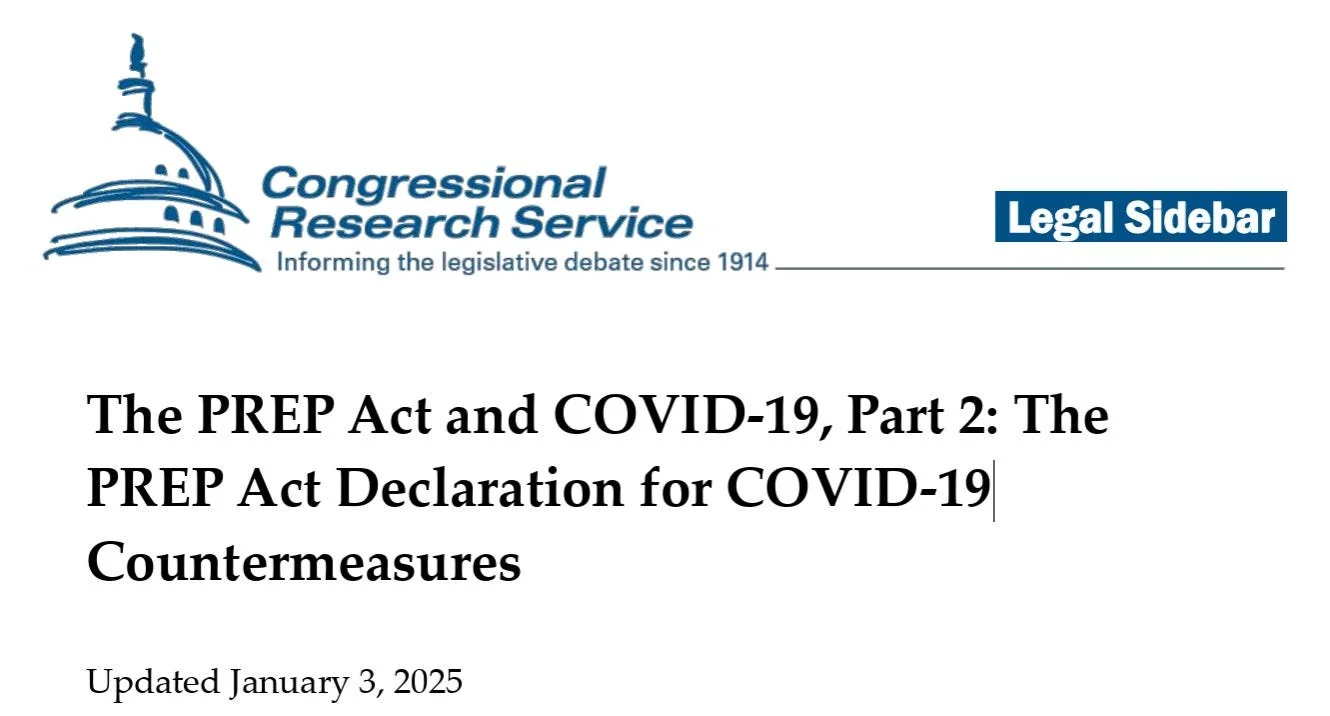
“The PREP Act and COVID-19, Part 2: The PREP Act Declaration for COVID-19 Countermeasures Updated January 3, 2025” can be found here.
The PREP Act: Unchecked Power, Zero Accountability, and a Path Forward
The linked Congressional Research Service document above explains how the federal government granted sweeping legal immunity to pharmaceutical companies, healthcare providers, and others involved in COVID-19 responses and beyond. What it doesn’t do is analyze the downstream ramifications of that legal immunity.
So, what does it all mean?
Summary
This Congressional Research Service document details how the federal government granted unprecedented legal immunity to pharmaceutical companies, healthcare providers, and others involved in COVID-19 countermeasures through the Public Readiness and Emergency Preparedness (PREP) Act. Beginning in February 2020, the Secretary of Health and Human Services declared that COVID-19 warranted sweeping liability protections, meaning that if someone was injured or died from a COVID-19 vaccine, treatment, or related product, they generally cannot sue for damages in court. The only exception is for “willful misconduct” causing death or serious injury—an extremely high legal standard that is very difficult to prove. Instead of accessing the traditional court system, injured individuals must seek compensation through a government program that has historically been difficult to navigate and provides limited relief.
The scope of these immunity protections expanded dramatically over time, with at least twelve amendments issued during both the Trump and Biden administrations. What began as emergency protections for COVID-19 vaccines and treatments eventually encompassed routine childhood vaccines, seasonal flu shots, respiratory protective equipment, and even telehealth consultations conducted across state lines. These declarations also represented significant federal overreach into state authority by explicitly preempting state licensing laws and allowing pharmacists, pharmacy technicians, students, and providers with expired licenses to administer vaccines and medications in ways that state laws wouldn’t normally permit. States effectively lost control over regulating medical practice within their own borders, all in the name of expanding the “pool” of vaccine administrators.
Perhaps most concerning from a conservative perspective is that these immunity protections continue well beyond the end of the public health emergency. While the federal COVID-19 emergency declaration terminated in May 2023, the liability shields for manufacturers and providers remain in effect through December 31, 2029—more than six years later. This arrangement prioritized rapid deployment and corporate interests in enabling medical products to be rushed to market while being shielded from normal liability standards.
Key Points
Broad Immunity from Lawsuits: Starting in February 2020, the Secretary of Health and Human Services invoked the PREP Act to shield manufacturers, distributors, and administrators of COVID-19 countermeasures from virtually all legal liability. If you were injured by a COVID-19 vaccine or treatment, you generally cannot sue for damages in court.
Limited Recourse for Victims: The only exception is for “willful misconduct” causing death or serious injury—an extremely high bar to meet. Instead of courts, injured individuals must seek compensation through a government program (CICP) that historically has been difficult to access and provides limited compensation.
Scope Expanded Repeatedly: The Trump and Biden administrations amended this declaration at least twelve times, continually broadening who and what received immunity. This eventually covered not just COVID-19 vaccines and treatments, but routine childhood vaccines, influenza shots, protective equipment, and even telehealth consultations across state lines.
Federal Overreach on State Authority: The declarations explicitly preempted state licensing laws, allowing pharmacists and others to administer vaccines and medications in ways that state law wouldn’t normally permit. States lost control over who could practice medicine within their borders.
Immunity Extended Through 2029: Despite the public health emergency ending in May 2023, immunity for COVID-19 countermeasures continues through December 2029—keeping pharmaceutical companies and providers protected from accountability for years to come.
Prep Act Powers and Responsibilities of the Secretary of HHS
Under the PREP Act, as described in this document, the Secretary of Health and Human Services wields extraordinarily broad and largely unchecked power to grant legal immunity across vast sectors of American healthcare and commerce. The Secretary has unilateral authority to declare a public health emergency and, through that declaration, immunize entire industries from lawsuits without meaningful congressional oversight or judicial review. This power extends far beyond simply protecting vaccine manufacturers—the Secretary can determine which diseases constitute emergencies, define what counts as a “countermeasure” deserving protection, decide who qualifies as a “covered person” eligible for immunity, and establish the timeframes during which these protections apply.
The document reveals how successive Secretaries exercised this authority expansively, amending the original COVID-19 declaration at least twelve times to continually broaden its reach. The Secretary redefined covered diseases to include not just COVID-19 itself, but vaguely defined “other diseases, health conditions, or threats that may have been caused by COVID-19” and even declining childhood vaccination rates. The Secretary expanded covered countermeasures to include routine pediatric vaccines, flu shots, and protective equipment. Most troublingly, the Secretary claimed authority to override state laws by preempting state licensing requirements and creating new categories of “qualified persons”—including students, those with expired licenses, and providers practicing across state lines—who could administer medical treatments regardless of what state legislatures had determined appropriate.
From a conservative standpoint, this represents a troubling concentration of power in a single unelected federal official with minimal accountability. The Secretary faces no requirement to consult Congress before issuing or amending these sweeping declarations, can extend immunity protections years beyond the end of actual emergencies, and relies on non-binding advisory opinions from the HHS General Counsel rather than on transparent rulemaking. This arrangement subordinates state sovereignty, individual rights, and traditional checks and balances to executive discretion, all while shielding powerful pharmaceutical and healthcare interests from the legal accountability that normally ensures product safety and quality in a free market.
Analysis of PREP Act Powers Under Loper Bright
The June 2024 Supreme Court decisions in Loper Bright Enterprises v. Raimondo and Relentless, Inc. v. Department of Commerce overturned the forty-year-old Chevron deference doctrine, which had required courts to defer to agency interpretations of ambiguous statutes. This landmark shift has profound implications for the expansive powers exercised by the HHS Secretary under the PREP Act as described in the CRS document.
The Core Problem: Chevron Is Dead
Under Loper Bright, courts must now exercise their independent judgment in deciding whether an agency has acted within its statutory authority and may not defer to an agency’s interpretation simply because a statute is ambiguous. Chief Justice Roberts wrote that it remains the responsibility of the court to decide whether the law means what the agency. This fundamentally changes how courts must review the Secretary’s PREP Act declarations.
Vulnerable Aspects of the PREP Act Implementation
1. Extraordinarily Broad Definitions
The HHS Secretary’s repeated expansions of what constitutes “covered countermeasures” and “covered persons” rest on interpretations of statutory ambiguity that would likely face much stricter judicial scrutiny post-Loper Bright. For example:
The Third Amendment’s expansion to include diseases “that may have been caused by COVID-19,” including declining childhood vaccination rates, represents a massive interpretive leap
Defining “administration” to include “activities and decisions directly relating to delivery, distribution and dispensing” goes far beyond the plain meaning of administering a medical product
Creating entirely new categories of “qualified persons”, including students, expired license holders, and cross-state practitioners, appears to exploit statutory silence rather than follow clear congressional authorization
Under Loper Bright, courts would need to determine independently whether Congress actually authorized such expansive interpretations, rather than deferring to HHS’s “reasonable” reading of ambiguous language.
2. Preemption of State Laws
The Secretary’s claim of authority to preempt state licensing laws and medical practice regulations is particularly vulnerable. The PREP Act’s preemption provision is limited, yet the Secretary used it to override state determinations about:
Who can administer vaccines
Age requirements for vaccination
Scope of practice for various healthcare providers
Cross-state licensure requirements
Post-Loper Bright, courts applying independent judgment would likely scrutinize whether Congress clearly authorized the Secretary to displace state sovereignty in these areas, especially given constitutional principles favoring state police powers over health and safety.
3. The “Authority Having Jurisdiction” Expansion
The Fourth Amendment’s advisory opinion stating that activities authorized by an “authority having jurisdiction” include those merely “recommended by applicable public-health guidance, such as CDC guidance” represents aggressive statutory interpretation. This transforms non-binding guidance documents into legal authorization for immunity—a reading that under Loper Bright would require clear congressional intent, not agency interpretation of silence.
4. Incorporation of Non-Binding Advisory Opinions
The Fourth Amendment’s explicit incorporation of HHS advisory opinions into the Declaration itself is particularly problematic. The document notes these opinions “are nonbinding and lack the force of law,” yet HHS formally integrated them into a declaration with legal effect. Under Loper Bright’s framework requiring judicial independence, courts would evaluate whether this self-referential bootstrapping reflects Congress’s intent or agency overreach.
5. Time Period Extensions Beyond Emergency
The statutory language allows the Secretary to identify time periods and extend them for reasonable disposition of countermeasures. However, extending immunity through 2029—six years after the emergency ended—for products that received full FDA approval (not just emergency authorization) appears to stretch “reasonable period” beyond recognition. Courts applying independent judgment under Loper Bright would examine whether Congress intended immunity to continue indefinitely beyond actual emergencies.
Likely Judicial Outcomes
The Supreme Court emphasized that courts can still look to agency expertise as informative but rejected the idea that agencies have special authority to resolve statutory ambiguity. Under this standard:
Strong Congressional Authorization (Likely Survives):
Basic authority to declare public health emergencies
Immunity for countermeasures directly purchased or authorized by federal contracts
Compensation through CICP for injuries from covered countermeasures
Weak Congressional Authorization (Vulnerable to Challenge):
Expansive definitions of “covered diseases” beyond the declared emergency
Broad categories of “covered persons” going beyond clear statutory language
Preemption of state medical licensing and practice laws
Immunity extensions years beyond emergency terminations
Incorporation of non-binding guidance as legal authorization
Major Questions Doctrine
The Court has articulated a “new major questions exception” following Loper Bright, which requires clear congressional authorization for agency actions of vast economic and political significance. The PREP Act’s grant of blanket immunity affects:
Multi-billion dollar pharmaceutical liability
Fundamental state regulatory authority
Individual constitutional rights to legal redress
Professional licensing across all states
...would likely qualify as a “major question” requiring explicit congressional direction, not agency gap-filling.
Constitutional Concerns
Beyond statutory interpretation, Justice Thomas’s concurrence emphasized that Chevron violated the separation of powers by requiring judges to abdicate their constitutional duty to resolve statutory ambiguity. The PREP Act implementation raises similar concerns about:
Executive usurpation of legislative authority to define liability standards
Interference with judicial power to interpret laws
Displacement of state sovereignty without clear federal authorization
Practical Impact
Any litigation challenging PREP Act immunity decided after June 2024 must be analyzed under Loper Bright’s requirement of independent judicial judgment. The aggressive interpretations of the twelve amendments—particularly those that expand coverage far beyond COVID-19 vaccines to routine healthcare products and services—would face significantly heightened scrutiny. Courts would need to find that Congress clearly authorized each expansion, not that HHS’s interpretation was merely “reasonable.”
The document’s description of HHS “broadening” and “expanding” definitions through successive amendments suggests exactly the kind of agency gap-filling and ambiguity exploitation that Loper Bright prohibits. Where the PREP Act is silent or ambiguous, courts must now determine the best interpretation themselves—they cannot defer to HHS’s policy preferences or claims of expertise.
What options does the current Secretary of HHS have to stop ongoing PREP Act protections?
Based on this Congressional Research Service document, the Secretary of HHS has significant discretion to terminate or limit PREP Act protections, though the document focuses more on how protections were expanded than how they can be curtailed. Here’s what the Secretary can do:
Direct Authority to End Protections:
The PREP Act explicitly allows the Secretary to designate effective time periods for immunity “by dates, or by milestones or other description of events.” This means the Secretary has clear statutory authority to simply declare an end date for PREP Act coverage. The Eleventh and Twelfth Amendments demonstrate this power—the Secretary chose to extend protections through December 31, 2024, and then again through December 31, 2029. By the same authority, the Secretary could amend the Declaration to set a much sooner termination date or tie the end of immunity to specific conditions being met.
Narrowing the Scope of Coverage:
Just as previous Secretaries repeatedly amended the Declaration to broaden definitions of “covered countermeasures,” “covered persons,” and “covered diseases,” the current Secretary could issue amendments that narrow these definitions back down. For example, the Secretary could remove the expansive language about “other diseases, health conditions, or threats that may have been caused by COVID-19” and limit coverage strictly to COVID-19 itself. The Secretary could eliminate the categories of “qualified persons” that allow pharmacy technicians, students, expired license holders, and cross-state practitioners to administer vaccines with immunity, thereby returning authority to state licensing boards.
Rescinding Specific Amendments:
The current HHS Secretary could specifically rescind problematic amendments, such as the Third Amendment’s coverage of routine pediatric vaccines or the provisions allowing telehealth across state lines. Since these were added through the Secretary’s interpretive authority rather than by statute, they could be removed the same way. The document notes that immunity for pharmacists to administer routine childhood vaccines (non-COVID vaccines) already ended in May 2023 with the Section 319 public health emergency, showing that protections can be allowed to sunset.
Declining to Extend or Renew:
The HHS Secretary has no obligation to continue extending protections. The fact that the Twelfth Amendment extended coverage through 2029 was a discretionary choice, not a requirement. The current Secretary could simply allow these provisions to expire on their current schedule or even accelerate their termination. The document notes the statute allows extensions beyond emergency declarations specifically “for the manufacturer to arrange for disposition of the covered countermeasure”, a much more limited purpose than blanket ongoing immunity.
Removing Federal Contracting as Basis for Immunity:
The document explains that immunity applies either to countermeasures related to federal contracts or those authorized by an “authority having jurisdiction.” The Secretary could clarify that once the federal government stops purchasing or distributing COVID countermeasures, the federal contract basis for immunity no longer applies. This would significantly narrow the scope of ongoing protections.
Reversing Incorporation of Advisory Opinions:
The Fourth Amendment explicitly incorporated the HHS General Counsel’s advisory opinions into the Declaration itself. The current HHS Secretary could issue an amendment removing this incorporation and clarifying that these opinions—which the document acknowledges “are nonbinding and lack the force of law”—do not form the basis for immunity determinations. This would eliminate some of the most aggressive interpretations, such as the claim that CDC guidance recommendations constitute authorization by an “authority having jurisdiction.”
Political and Practical Considerations:
From a conservative perspective, ending these protections would restore several important principles: accountability for pharmaceutical companies and healthcare providers, state sovereignty over medical licensing and practice, individual rights to seek legal redress for injuries, and proper limits on executive power. The HHS Secretary could frame amendments as returning to the original, more limited scope intended for genuine emergencies rather than maintaining permanent liability shields for routine medical products.
However, the pharmaceutical industry and healthcare lobby would undoubtedly pressure the Secretary heavily to maintain protections, arguing that ending immunity would discourage vaccine production and healthcare services. A politically conservative Secretary would need to weigh these competing interests while recognizing that six years after the emergency began and four years after vaccines became widely available, extraordinary immunity provisions no longer serve their original emergency purpose.
The Bottom Line:
The HHS Secretary has broad authority to terminate, narrow, or allow to expire the PREP Act protections through the same amendment process used to expand them. Nothing in the statute requires maintaining immunity indefinitely, and the same discretionary power used to extend protections through 2029 could be used to end them much sooner. The question is not whether the Secretary has the legal authority to act, but whether the current HHS Secretary has the political will to restore normal liability standards and state regulatory authority over medical practice.
Summary and Conclusion
The Public Readiness and Emergency Preparedness (PREP) Act represents one of the most sweeping grants of immunity from legal liability in American history. Since February 2020, the Secretary of Health and Human Services has used this authority to shield pharmaceutical companies, healthcare providers, and countless others from lawsuits—even when their COVID-19 vaccines, treatments, or related products cause serious injury or death. If you or a loved one suffered harm from a COVID-19 vaccine, you generally cannot sue in court. Your only recourse is a government compensation program that is notoriously difficult to navigate and provides limited relief.
What began as emergency protection for experimental vaccines expanded far beyond its original purpose. Through twelve amendments across two administrations, federal bureaucrats continuously broadened these immunity shields to cover routine childhood vaccines, seasonal flu shots, protective equipment, telehealth consultations, and an ever-growing list of people authorized to administer these products. The federal government explicitly overrode state medical licensing laws, allowing pharmacy technicians, students, and even healthcare workers with expired licenses to provide medical treatments—all while enjoying complete protection from accountability.
Most troubling is the timeline: despite the COVID-19 public health emergency ending in May 2023, these extraordinary liability protections remain in effect through December 31, 2029—more than six years after the emergency concluded. This isn’t about emergency response anymore; it’s about permanent corporate protection at the expense of individual rights.
The Constitutional Crisis
This arrangement concentrates enormous power in a single unelected official—the HHS Secretary—who can unilaterally grant immunity to entire industries without meaningful congressional oversight or judicial review. The Secretary can redefine diseases, create new categories of protected persons, override state sovereignty, and extend protections indefinitely. This flies in the face of constitutional separation of powers, federalism, and the fundamental right to seek justice in court when harmed.
States lost control over medical practice within their own borders. Individuals lost their day in court. Congress lost its legislative prerogative. And pharmaceutical companies gained a liability-free environment to rush products to market without the accountability that normally ensures safety and quality.
The Loper Bright Game-Changer
The Supreme Court’s June 2024 decision in Loper Bright Enterprises v. Raimondo fundamentally changed the legal landscape. By overturning Chevron deference, the Court ruled that judges must independently determine what statutes mean—they can no longer rubber-stamp agency interpretations just because the law is ambiguous. Courts must now ask: Did Congress clearly authorize what this agency is doing?
Applied to the PREP Act, many of the Secretary’s expansive interpretations become legally vulnerable:
Expanding “covered diseases” to include vaguely defined conditions and declining vaccination rates appears to exploit ambiguity rather than follow clear congressional intent
Preempting state medical licensing laws intrudes on core state sovereignty without explicit congressional authorization
Extending immunity six years beyond the emergency stretches “reasonable disposition period” beyond recognition
Incorporating non-binding advisory opinions into legally binding declarations constitutes self-referential bootstrapping
Treating CDC guidance as legal authorization transforms recommendations into mandates without congressional approval
Under Loper Bright, courts must independently judge whether Congress actually authorized these actions. The answer, in many cases, appears to be no.
The Path Forward
The incoming HHS Secretary has clear legal authority to reverse course. The same amendment power used to expand protections can narrow or eliminate them. Specifically, the Secretary can:
Set a firm end date for PREP Act immunity, rather than extending it through 2029
Narrow definitions of covered diseases, countermeasures, and persons back to their original scope
Rescind specific amendments that overreach into state authority and routine healthcare
Remove incorporation of advisory opinions that lack the force of law
Clarify that federal contract immunity ends when the government stops purchasing countermeasures
Allow provisions to sunset rather than continuously extending them
The question isn’t whether the Secretary has legal authority to act, it’s whether the Secretary has the political will to restore accountability, state sovereignty, and individual rights in the face of pharmaceutical industry pressure.
What’s at Stake
This isn’t just about COVID-19 vaccines. It’s about fundamental principles:
Rule of Law: No industry should operate above accountability indefinitely
Federalism: States, not federal bureaucrats, should control medical licensing and practice
Individual Rights: Americans deserve their day in court when harmed by defective products
Separation of Powers: One unelected official shouldn’t wield unchecked authority over billions of dollars in liability and state regulatory power
Free Market Accountability: Legal liability ensures companies prioritize safety and quality
Six years after the pandemic began, with widely available and fully FDA-approved vaccines, there is no justification for maintaining emergency immunity shields. The emergency is over. The extraordinary powers granted to meet it should end too.
Conclusion
The PREP Act’s implementation reveals how quickly emergency powers, once granted, become permanent fixtures that serve corporate interests rather than public health. Unchecked executive authority expanded protections far beyond their statutory purpose, trampling state sovereignty and individual rights along the way.
The Supreme Court’s Loper Bright decision provides a constitutional roadmap for challenging these overreaches in court. But the most direct path forward is executive action: the current HHS Secretary can and should use the same amendment authority that expanded these protections to narrow or eliminate them.
Restoring accountability isn’t anti-vaccine or anti-healthcare; it’s pro-responsibility, pro-federalism, and pro-individual rights. It’s insisting that in America, no one operates above the law forever, and that emergency powers return to normal limits when emergencies end. That’s not just a conservative principle, it’s a constitutional necessity.