
The Seven Techniques of the Pandemic Grift
A framework for spotting the structure when the next one starts.
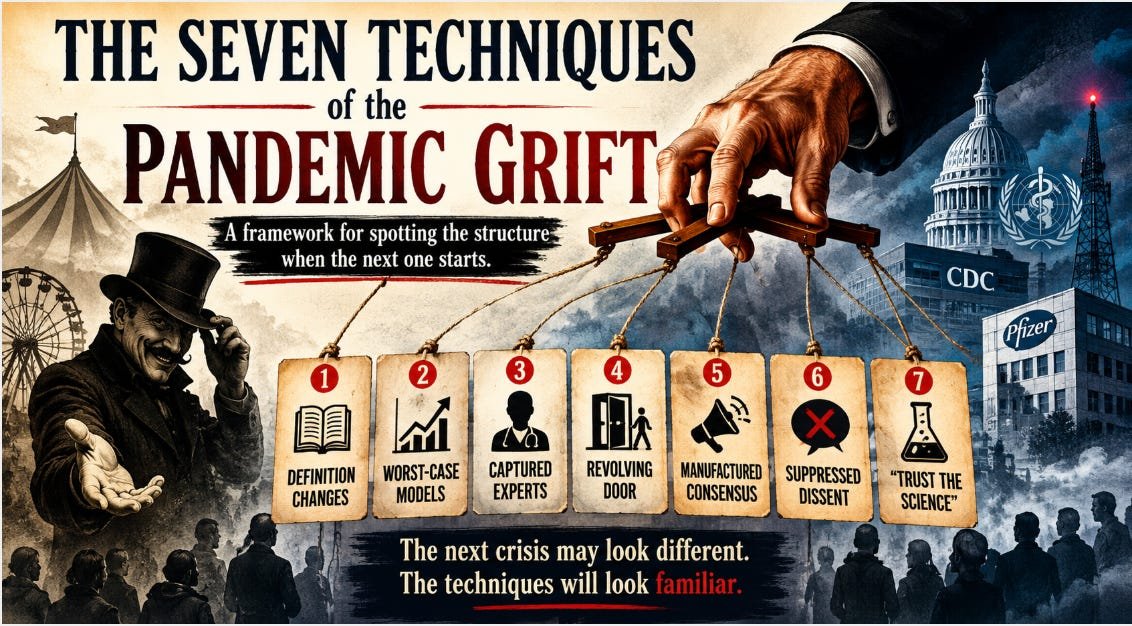
In 1902, an American newspaper printed a word for a kind of small-time swindler who worked carnivals, racetracks, and hotel lobbies. The word was “grift.” It described a hustler who lifted small sums from a long succession of marks, never enough from any one of them to make resistance worth the cost. Through the 1930s, when David Maurer wrote the definitive study of these operators, the grift remained a category of petty crime: confidence work performed by individuals on individuals.
The word has outlived the world it described. The hustler at the racetrack is mostly gone. The structure he worked is not. What changed is the scale.
Read the public-health record of the last five years with the structure of a con in mind, and the events stop looking like a sequence of mistakes. They start looking like a sequence of stages: setup, convincer, send, touch, blowoff, fix. No one wrote it down as a script. No one had to. The structure of extraction at scale produces these stages whether the operators recognize what they are doing or not. This essay is about how to recognize the pattern in the public-health context. It draws on the technical literature of confidence work to do so, because that literature is the most honest account anyone has written of how the trick is done.
What a grift actually is
The standard meaning of fraud is a discrete act: someone tells a lie, someone hands over money, and a transaction is consummated. A grift is something different. It is a structure designed to produce a steady transfer of resources from a many to a few, often without any single act that would be recognized as criminal by a court. The grift sets the terms. The marks fall into them.
The most useful starting point for understanding how this works comes from outside the con-artist literature altogether. Gavin de Becker, who has spent his career studying interpersonal predation, makes an observation that travels: charm is not a personality trait. It is, in his words, “almost always a directed instrument which has motive.” When someone is being especially charming to you, the right question is not whether you like them. The right question is what they want.
This is a hard observation to absorb because it cuts against the social grain. Most of us have been taught that responding to charm is good manners. de Becker’s point is that charm in the absence of an established relationship is a tool, and the tool always has a purpose. Watch for the deployment and you start to see the purpose.
The institutional analogue is straightforward. When a large organization is being especially reassuring to you, when its messaging is unusually emotive, when its experts are unusually photogenic, when the call to action is unusually urgent, the right question is not whether you trust the speakers. The right question is what the operation wants, and what it is positioned to gain if you cooperate.
A confidence game at scale requires four conditions. Each was present, in unusual concentration, in the pandemic period.
The first is fear. The fear does not have to be unjustified. In fact, the most durable grifts are the ones in which the underlying risk is real. A real threat is what makes the mark willing to suspend the ordinary checks he would apply to a stranger asking for his money or his liberties. The grift does not need to invent the fear. It only needs to amplify it, sustain it, and direct it toward the operation’s preferred response.
The second is urgency. Time pressure is the standard tool of the confidence operator because it disables the ordinary process of comparison and verification. A mark who is told he has weeks to decide will check his references. A mark who is told he has hours will not. The pandemic produced a sustained condition of artificial urgency, in which “we have to act now” was invoked to compress what would normally have been multi-year regulatory and political deliberations into days and weeks.
The third is information asymmetry. The mark has to believe that the operator knows something he does not. In an infectious-disease outbreak, this condition arrives naturally: the public genuinely does not know what is in the air, and the institutions claiming to know are the institutions on which the public must rely. The asymmetry is real. What the grift requires is that the asymmetry be preserved against any voice that would close it. Dissenting experts who could give the public a second opinion are precisely the threat the operation must neutralize.
The fourth is concentrated spending. The grift is not interesting to its operators unless the prize is large and goes to a few hands. The pandemic response produced one of the largest mobilizations of public money in the history of the developed world, and the disbursement was structured around a small number of well-positioned recipients. The setup was almost ideal for what followed.
Put the four conditions together and the rest becomes legible. Each technique catalogued in the next section operates on one or more of these conditions. The grift is not a single move; it is a system of moves that together produce the transfer.
Our work below is for our paid subscribers. Subscribe to read about case examples and the seven techniques commonly used in pandemic grifting
Three older cases
If the framework feels abstract, three recent confidence games at scale illustrate it before we apply it to public health.
The 2008 financial crisis is the cleanest American example in living memory. The grift was not the bad mortgages themselves; it was the regulatory and ratings architecture that allowed a class of securities known to be defective to be sold to pension funds and municipalities as investment-grade. When the structure collapsed, the firms that had built and sold it were rescued at public expense, and the marks (homeowners, retirees, ordinary investors) absorbed the losses. The grift’s signature: a few took, the many paid, no one was prosecuted, the public was told the operation was too important to fail.
The Iraq War’s aftermath is a second illustration. The reconstruction effort moved hundreds of billions of dollars through a procurement system that produced famously little reconstruction. The arrangement was sustained by the same conditions any grift requires: a real underlying threat (terrorism, weapons of mass destruction, regional instability), manufactured urgency, an information asymmetry between the war planners and the public, and a concentrated spending pool that went to a small number of well-connected contractors. The accountability arrived years late, in diluted form, and never reached the architects.
The third example is more domestic. American higher education over the last forty years has produced one of the largest single transfers of wealth from young people and their families to a credentialing class in modern history. The product, a degree, has been sold under a steady drumbeat of fear (you will be unemployable without one), urgency (you must enroll immediately, before tuition rises further), information asymmetry (the value of any given degree is opaque until after purchase), and concentrated spending (tuition payments now flow through a handful of large institutions whose administrative ranks have grown faster than their faculties). The grift is structural, not personal. No individual professor or administrator is acting as a con man. The structure does the extracting for them.
These three cases share a feature worth naming. In none of them was anyone directing the grift in the sense a Maurer-era con man directed his crew. The grift emerged from the interaction of incentives, asymmetries, and the failures of accountability that the structure made available. That is how grifts at scale work. The script writes itself.
The seven techniques
When confidence operators in the pre-war American underworld talked about their craft, they had a vocabulary for it. The setup. The rope. The convincer. The touch. The blowoff. The fix. Each named a stage. Each had its own techniques.
The grifts that thrive in modern public health response have their own techniques. They are less colorfully named, but they are just as identifiable, and they recur with enough regularity across cases that anyone who has seen them once can spot them the next time. The following seven are the most consistent.
1. Definitional manipulation
The cleanest documented case is the World Health Organization’s revision of its pandemic definition in May 2009, on the eve of declaring H1N1 a pandemic. The previous definition required “enormous numbers of deaths and illness.” The revised definition dropped the severity requirement, leaving only the criterion of geographic spread. Within weeks, the WHO declared an “official pandemic,” triggering pre-negotiated contracts that obligated governments to purchase billions of doses of H1N1 vaccine. The pandemic, on its old definition, did not arrive. The vaccine purchases did.
A subsequent investigation by the Council of Europe accused the WHO of a “false pandemic” influenced by industry interests. The investigation was followed by no consequence to any official. The definition has been quietly revised since.
The same technique was deployed during the COVID period with the definition of “vaccine” (modified by the CDC in September 2021 to remove reference to immunity), with the definition of “gain-of-function research” (narrowed by U.S. funding agencies in ways that made certain pre-pandemic projects no longer count as such), and with the definition of “fully vaccinated” (revised repeatedly as efficacy claims required adjustment). Each revision was defended on technical grounds. The cumulative effect was that the words officials used to describe their conduct meant whatever the moment required.
2. Worst-case modeling
Any mathematical model produces whatever output you ask it to produce, given the right assumptions. A model is a structure for arguing. When a model is presented as a finding, the relevant question is always: who chose the assumptions, and what would the output have been under different ones?
Imperial College London’s pandemic modeling group, led by Neil Ferguson, supplied the most consequential worst-case projections of the COVID period. Its March 16, 2020 paper projected 500,000 deaths in the United Kingdom and 2.2 million in the United States under a “do nothing” scenario, with substantial reductions only under sustained lockdown. The paper was credited with persuading the British and American governments to adopt the lockdown response. Several months later, the model’s source code became public and was examined by independent reviewers, who described it as a buggy single-threaded simulation whose outputs were not reproducible from the same inputs.
The track record of the group that produced this work was on the public record before the COVID projection ran. In 2002, Ferguson’s team had projected up to 150,000 deaths from BSE-related causes; the eventual figure in the UK was 178. In 2005, Ferguson told The Guardian that as many as 200 million people globally could die from avian influenza; the eventual figure was a few hundred. In 2009, the group projected 65,000 UK deaths from swine flu; the actual figure was 457. The pattern of dramatic overprojection followed by no professional consequence is documented in the public record.
Michael Osterholm of the University of Minnesota’s Center for Infectious Disease Research and Policy followed a similar pattern of high-profile worst-case projections across H5N1, H1N1, Ebola, and COVID, in each case followed by personal advancement and institutional funding. The point is not to claim any individual modeler is dishonest. The point is that the worst-case projection is, structurally, the model output most useful to the operation that wants policy compliance, and the modeler who reliably produces it is the modeler who reliably gets the next contract.
3. Captured experts
The advisory panel staffed with scientists who hold industry consulting agreements is the standard furniture of modern regulation. A 2018 Science investigation by Charles Piller examined post-approval payments to Food and Drug Administration advisory committee members involved in pharmaceutical approval votes. Two-thirds of the physicians studied had received payments from the manufacturers of the drugs they had voted on, or from competing manufacturers, after the approval. Eleven members received over a million dollars each. The disclosures were post-approval and therefore did not appear in the deliberations that produced the votes.
Capture operates at the institutional level as well as at the individual level. The Coalition for Epidemic Preparedness Innovations, the U.S. Biomedical Advanced Research and Development Authority, the World Health Organization’s vaccine advisory bodies, and various national counterparts have governance structures that include the very companies whose products they evaluate, fund, and recommend. The relationships are disclosed in the institutions’ own materials. They are simply not described, in public discussion, as what they structurally are.
4. The revolving door
The senior Food and Drug Administration official who joins the board of the pharmaceutical company whose products he formerly regulated. The Centers for Disease Control director who departs for a senior position at a vaccine manufacturer. The pattern is documentable across multiple institutions and multiple decades.
The revolving door shapes regulatory behavior through anticipated career consequences, not through any explicit quid pro quo. An official who knows that a hostile decision against a major company will close future career options behaves accordingly. The same official, asked under oath whether he was bribed, can truthfully say he was not. He was not. He was something else. The structure of the door is what produced the behavior.
The pharmaceutical industry’s recruitment of former regulators is not the only revolving-door pattern relevant to pandemic-era operations. The same pattern operates between national security agencies and the platforms whose content-moderation operations they later shaped, between health agencies and the nongovernmental organizations that perform “civil society” functions, and between research-funding bodies and the laboratories whose grants they oversee.
5. Manufactured consensus
In February 2020, The Lancet published a letter signed by twenty-seven scientists declaring the lab-leak hypothesis a conspiracy theory. The letter was organized by Peter Daszak of the EcoHealth Alliance, the New York based nonprofit that had collaborated with the Wuhan Institute of Virology on the very research the letter was designed to make unspeakable. Daszak’s name appeared as one signatory among many. His financial and professional interest in foreclosing the lab-leak inquiry was not disclosed.
In March 2020, Nature Medicine published the “Proximal Origin” paper by Kristian Andersen, Robert Garry, Edward Holmes, Andrew Rambaut, and W. Ian Lipkin, concluding that SARS-CoV-2 was not a laboratory construct. Emails between the authors and Anthony Fauci, released years later under congressional subpoena, showed that the authors had privately expressed serious concern about the possibility of laboratory origin while drafting the paper, that they had been in contact with Fauci about the manuscript before publication, and that the paper’s conclusions were arrived at under circumstances that did not resemble the normal scientific process described to the public.
These two documents anchored the public understanding that the lab-leak hypothesis was scientifically disreputable. The understanding lasted years. It was sustained by the apparent unanimity of a credentialed expert class. The unanimity was manufactured. The technique works because most people lack the time, training, or appetite to examine the underlying papers; they take the consensus as given and update their views accordingly. The manufactured consensus is the input most easily produced by the institutions that need it to be true.
6. Suppression of dissent
Credentialed scientists who disagree with the consensus position are uninvited from advisory panels, denied grants, demonetized on platforms, retracted from journals, and removed from professional positions. The Great Barrington Declaration, published in October 2020 by Jay Bhattacharya of Stanford, Martin Kulldorff of Harvard Medical School, and Sunetra Gupta of Oxford, called for an age-stratified pandemic response that would focus protection on those most vulnerable while allowing lower-risk populations to resume ordinary life. Within days of publication, the National Institutes of Health director, Francis Collins, emailed Anthony Fauci that the Declaration required “a quick and devastating published takedown.”
Fauci replied that the takedown had already begun. Coordinated criticism followed, the Declaration’s authors were characterized as “fringe epidemiologists” by the institutional response, and their public-platform reach was substantially curtailed. The authors held credentials at three of the most distinguished universities in the world. The “fringe” characterization was a manufactured label, not a description of their professional standing.
The technique is the suppression of dissent. The point is not that the dissenters were necessarily correct. The point is that a consensus enforced by institutional retaliation against credentialed disagreement is not a scientific consensus. It is a political one wearing the costume of science. Once the costume is recognized, much else becomes legible.
7. The weaponization of “Trust the science”
Science is a method, not a position. It is a procedure for arriving at provisional conclusions through testable hypotheses, replicable experiments, and the willingness to abandon a claim when the evidence requires it. “Trust the science,” as the phrase was deployed during the pandemic, did not mean any of this. It meant: defer to the institutions that have positioned themselves as the spokesmen for science.
The swap operates at several levels. It substitutes authority for evidence. It substitutes consensus for procedure. It substitutes the speaker’s institutional position for the substance of his claim. And it produces an effect that real science could never produce: a closed question, with dissent characterized as ignorance or bad faith.
Operationally, “trust the science” during the pandemic produced consequences that real science would not have. It produced six-foot distancing rules that nobody could find the empirical basis for after the fact. It produced school closures that the available evidence at the time did not support, and the subsequent evidence has continued to indict. It produced mask mandates whose efficacy is still genuinely contested in the literature. It produced vaccine mandates for populations in which the underlying risk-benefit calculation never supported them. In each case, “the science” was invoked to close discussion. In each case, the underlying science was either thinner than the public was told, or actively in tension with the policy being defended.
Politically, “trust the science” worked as a shield against accountability. Officials who were wrong on the substance could deflect criticism on the procedure: they had followed the science. Critics could be dismissed as deniers of science itself, rather than as people raising specific empirical questions about specific claims. The argument moved from the territory of evidence to the territory of identity, which is exactly where the institutions wanted it.
Richard Feynman’s observation that “science is the belief in the ignorance of experts” captures what the weaponization of “trust the science” inverted. Real science is the discipline of mistrust. The slogan that traveled in its name was the opposite.
How the techniques combine
These seven techniques rarely appear alone. They appear as packages, with the techniques amplifying each other.
A pandemic begins. The definition of pandemic has been pre-adjusted to lower the threshold for declaration (technique 1). Worst-case models from credentialed experts produce dramatic projections (technique 2), the experts in question hold significant industry ties (technique 3), and the agencies receiving and amplifying their projections are staffed by officials whose post-government careers depend on the institutions whose products will be deployed in response (technique 4). A consensus is rapidly assembled through coordinated letters, statements, and media appearances (technique 5), and the credentialed scientists who disagree are sidelined, smeared, or removed from their positions (technique 6). The whole edifice is defended as “the science” (technique 7), with skeptics painted as enemies of reason itself.
The transfers follow. Billions in advance-purchase agreements move from public treasuries to a small number of well-positioned firms. Liability shields are erected to protect the manufacturers from any harm their products may cause. The dissenters who would have flagged the problems before they were locked in have been removed from the rooms where the decisions are made. By the time the public is in a position to ask hard questions, the contracts have been signed, the doses delivered, and the money disbursed.
The blowoff arrives in due course. The harms are minimized, the criticism is absorbed into a discourse the institutions control, and the public is encouraged to move on. The structure remains in place for the next iteration.
This is not a conspiracy theory. It is a structural account. Nobody had to coordinate. The incentives at each node produced behavior that, in aggregate, looked exactly like coordination. The grift emerged from the architecture. That is what grifts at scale look like.
What this lets you see
The framework does not require you to attribute bad faith to any particular individual. Most of the people inside the institutions described above are doing their jobs as they understand them, navigating an incentive structure they did not design, and many of them have paid genuine moral costs for the role they played. The structural account treats them honestly: as agents inside a system that was producing extraction whether they recognized it or not.
What the framework lets you see, having absorbed it, is the pattern. The next definitional revision will look familiar. The next worst-case model, presented as a finding rather than as a structure for argument, will look familiar. The next coordinated statement from a credentialed expert class with documentable industry ties will look familiar. The next dissenting scientist who is removed from her position for reasons described as scientific will look familiar. The next slogan that closes a question by appealing to “the science” will look familiar.
Recognition is the first move that breaks the operation. A confidence game requires the cooperation of the mark. The mark who recognizes what is being done to him is, by that fact, a less useful mark. The marks who, in aggregate, recognize the structure are an audience the operation cannot easily exploit.
The institutions described here are not omnipotent. They depend, in the end, on the willingness of ordinary people to extend the credibility that makes the operation possible. That credibility is the one resource the system cannot manufacture for itself. It has to be given. Which means it can be withheld.
That is the leverage. It always was.